
Free Cars for Low Income Families
By the Low Income Households Editorial Team · Last updated: October 26, 2026 · Reviewed against official and program sources listed at the end of this article
Quick Answer: Can You Get a Free Car?
Yes, a free car is possible, but it is rare and it is not a government benefit. Free cars for low income families come from nonprofits and charities that give away donated, repaired or refurbished vehicles to people who meet income and need requirements. Programs include Free Car Foundation, Vehicles for Change, Good News Garage, Cars 4 Heroes and 1-800-Charity Cars. Apply to several, never pay a fee to apply, and expect to pay for title, registration and insurance.
Key Takeaways
- No federal “free car” program exists. Offers claiming a government car voucher are scams.
- Free Car Foundation states on its website that it gives donated cars to people who need reliable transportation, with a free online application and no Social Security number required to apply.
- Typical eligibility: adult U.S. resident, low household income, a valid or obtainable driver’s license, no working vehicle and a clear transportation need.
- “Free” still has costs: budget for title, registration, insurance and repairs.
- Apply widely. Programs differ by state, group served and supply of vehicles.
- Check your benefits. A donated car may affect SNAP, Medicaid or housing rules in some states.
What Are Free Car Programs?
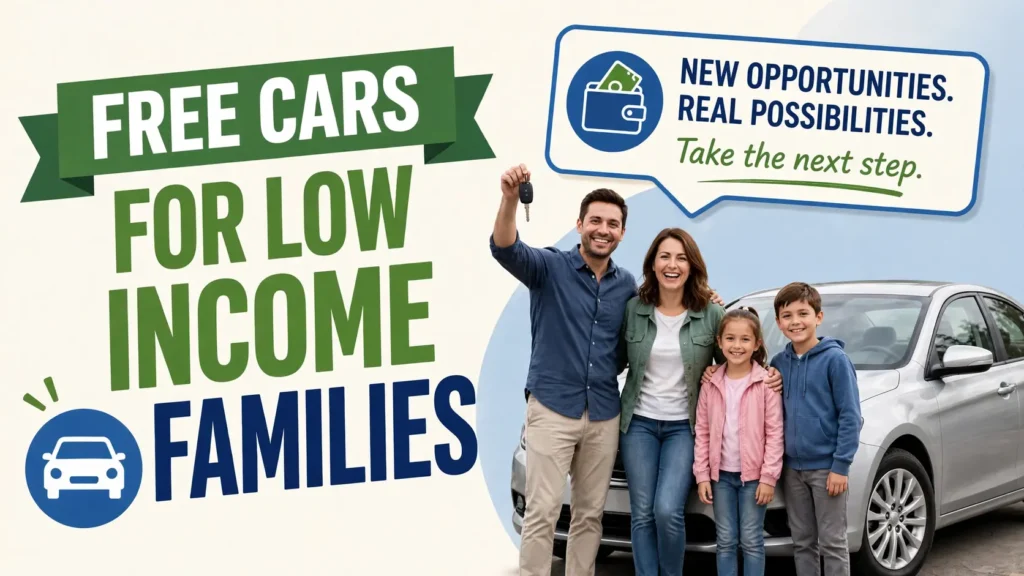
Free car programs are charitable programs that give vehicles to people who cannot afford one. Most cars come from donations by individuals, dealers or businesses. The charity inspects or repairs each car, then matches it with an approved applicant. Some programs give the car at no cost, while others sell it at a very low price or help you finance it with a low-interest loan. For example, Vehicles for Change describes much of its work as low-cost cars rather than purely free ones.
Why Reliable Transportation Matters
A car can decide whether someone keeps a job, gets to dialysis, takes children to school or leaves an unsafe home. That is why nonprofits prioritize single parents, veterans, seniors, people with disabilities, survivors of domestic violence and low-income working families.
Free Car Foundation: Free Cars for Low Income Eligible Families
Free Car Foundation is a U.S. nonprofit that, according to its website, gives donated cars to people who need reliable transportation and also publishes guides on car repair help, gas assistance, car insurance and scam warnings. We reviewed its site in October 2026. The details below come from what the organization publishes, so confirm the latest rules on its official pages.
Free Car Foundation Eligibility Requirements
According to the organization’s eligibility page, applicants should generally:
- Be a U.S. resident aged 18 or older
- Have a valid driver’s license, or be able to get one before a car is awarded
- Have household income at or below about 200% of the federal poverty level
- Have no working, reliable vehicle in the household
- Show a clear need, such as work, job training, medical care, school or family safety
- Be able to pay title, registration and insurance costs if awarded a car
Free Car Foundation Income Guide (Approximate)
| Household Size | About 200% of Poverty Level (2026) |
|---|---|
| 1 person | About $31,300 |
| 2 people | About $42,300 |
| 3 people | About $53,300 |
| 4 people | About $66,000 |
| Each additional person | Add about $11,000 |
These are estimates for the 48 contiguous states, and Alaska and Hawaii are higher. Check the official HHS poverty guidelines for exact numbers.
Who Free Car Foundation Prioritizes
The organization says it focuses on single parents, veterans, people with disabilities, seniors, survivors of domestic violence and low-income working families. It also publishes guides for foster youth, college students, nurses and teachers, and formerly incarcerated people.
How the Free Car Foundation Process Works
- Apply online. The application takes about 5 minutes and is free.
- Application review. The team reviews your information.
- Vehicle match. If selected, you are matched with a donated car.
- Register, insure and drive. You complete title, registration and insurance.
You do not need documents to apply. If you are selected, the organization says it may ask to see your driver’s license, proof of income and proof of address through a secure process. It states that it never asks for these by text message or social media and never charges application fees or asks for bank or card details.
Realistic Expectations
Applying does not guarantee a vehicle, and the organization says so on its own site. Read its page on the real cost of a donated car, which estimates $500 to $1,500 or more for title, tax, registration and insurance.
How to Verify Any Free Car Charity Before Applying
We recommend checking every program, including this one, before sharing personal details:
- Search the organization in the IRS Tax Exempt Organization Search to confirm nonprofit status.
- Look it up on Charity Navigator or the BBB Wise Giving Alliance.
- Check your state attorney general’s charity registry.
- Confirm that the physical address, phone and email match across its website and public listings.
- Walk away if anyone asks for money to apply.
Free Car Foundation lists contact@freecarfoundation.org and a Los Angeles, California address on its website. Low Income Households is an independent information site and is not affiliated with Free Car Foundation or any program listed here.
Other Free Car and Low-Cost Car Programs
| Program | Where | Who It Helps | Notes |
|---|---|---|---|
| Vehicles for Change | Maryland, Virginia, Washington D.C. area and Detroit | Low income working families, often referred by a partner agency | Mostly low-cost, refurbished cars |
| Good News Garage | Vermont and parts of New England | Low income workers, often through welfare-to-work referrals | Focus on job transportation |
| Cars 4 Heroes | Nationwide | Veterans, military families and first responders | Application by group |
| 1-800-Charity Cars and FreeCharityCars.org | Nationwide | Working poor families, survivors of domestic violence, veterans, people with medical needs | Review who can apply first |
| WithCauses.org network | Nationwide | Individuals and families in need | Request help through its form |
| NABC Recycled Rides | Through participating collision repair shops | People nominated by a local nonprofit | Ask local charities about nominations |
Availability, service areas and rules change often. Confirm details on each program’s official site.
Does the Government Give Free Cars?
No. The federal government does not run a program that gives cars to the public. Anyone advertising a “government car voucher” is a scam. Government help is more indirect:
- TANF and welfare-to-work programs can sometimes cover car repairs, insurance or transportation costs. Ask your state benefits office or find it through Benefits.gov.
- Workforce programs at American Job Centers may help with transportation for training or work. Search CareerOneStop.
- VA automobile grants may help eligible veterans with certain service-connected disabilities buy or adapt a vehicle. See VA.gov.
- Medicaid non-emergency medical transportation gives rides to covered medical appointments in many states. Learn more at Medicaid.gov.
- State vocational rehabilitation agencies sometimes fund vehicle modifications for work.
Real Costs of a “Free” Car
| Cost | What to Expect |
|---|---|
| Title transfer | State fee, varies |
| Registration and plates | State fee, varies |
| Sales or use tax | Some states charge it even on gifted cars |
| Insurance | Required in nearly every state |
| Inspection or emissions test | Depends on your state |
| Repairs and maintenance | Donated cars may need work |
| Gas | Ongoing monthly cost |
Set aside a few hundred to over a thousand dollars before you apply. If you cannot afford these costs, ask a program about payment help, and also look at gas and repair assistance, which are covered below.
Will a Free Car Affect Your Benefits?
It can. In some states and programs, a donated vehicle may count as an asset or income when benefits like SNAP, Medicaid or cash assistance are reviewed. Many states exempt at least one vehicle, but rules vary. Before you accept a car, call your caseworker or check with the agency. Do not guess.
How to Get a Free Car: Step by Step
- Confirm your need. Write down why you need a car, such as commuting, medical visits or school.
- Get your license in order. Most programs require a valid license. Check your state DMV for reinstatement or new license steps.
- Gather documents. Photo ID, proof of income, proof of address, benefit letters and insurance quotes.
- Budget for costs. Plan for title, registration and insurance.
- Apply to several programs. Start with Free Car Foundation, then apply to programs that fit your state and situation.
- Contact local help. Call 211 or visit 211.org, churches, community action agencies and local charities.
- Follow up and keep records. Save confirmation emails and respond fast to requests.
- Prepare a backup plan. Look at repair help, low-cost cars and transit while you wait.
How to Improve Your Chances
- Give complete and honest information. Mismatches cause delays.
- Describe your need clearly and briefly, such as “I need a car to reach a job 18 miles away that has no bus service.”
- Apply to programs that match your group, such as veterans, single parents or people with disabilities.
- Ask a social worker, job counselor, church or nonprofit to refer or nominate you.
- Keep your phone and email active.
- Reapply if the program allows it.
Free Car Scams: How to Protect Yourself
Free car scams are common, and they target people in difficult situations. Be cautious if you see any of these:
- A fee to apply, “reserve” or “ship” a free car
- A message saying you won a car you never entered for
- A request for your Social Security number, banking details or gift cards
- Pressure to act today
- A “government car voucher program,” which does not exist
- Contact only through text or social media
If you already shared information, contact your bank, freeze your credit through IdentityTheft.gov and report the scam at ReportFraud.ftc.gov. For more on avoiding fake offers, see our free phone scams guide.
Alternatives If You Cannot Get a Free Car
- Car repair assistance: Fixing your current car can be faster than waiting for a donated one. Ask 211, community action agencies and charities.
- Gas assistance: Local charities and churches sometimes offer limited gas cards.
- Low-income car insurance: California and New Jersey have state low-cost auto insurance programs, and other states may offer discounts.
- Community car loans: Some nonprofits offer low-interest loans that build credit.
- Cheap reliable used cars: Choose a simple model, ask for a service history and get an independent mechanic inspection before you buy.
- Public transit discounts: Many cities offer reduced fares for low income riders, seniors and people with disabilities.
- Rides to medical visits: Ask Medicaid, your health plan or local senior services.
Free Car Programs by Group
Single Mothers and Low-Income Families
Prioritize programs that favor working parents, and ask child care or workforce programs for referrals. Free Car Foundation names single parents and low-income working families as priority groups.
Veterans and Military Families
Start with Cars 4 Heroes, then check VA benefits and veteran service organizations.
People With Disabilities
Ask about accessible vehicles, wheelchair van grants, state vocational rehabilitation and VA programs where applicable.
Seniors
Look at Area Agencies on Aging through the Eldercare Locator for rides and transportation vouchers.
Survivors of Domestic Violence
Contact a local domestic violence program through TheHotline.org for safety planning and transportation help.
Frequently Asked Questions About Free Cars
Can you really get a free car?
Yes, but it is uncommon. Nonprofits and charities give donated, refurbished or repaired cars to eligible low income applicants, but demand is high, supply is limited and the government does not run a general free car program.
Is Free Car Foundation legit?
Free Car Foundation presents itself as a nonprofit that gives donated cars to people who need transportation, and its website states that applying is free and never requires a Social Security number. Before you apply, verify any charity yourself through the IRS Tax Exempt Organization Search, Charity Navigator or your state attorney general’s charity registry.
Who qualifies for a free car?
Requirements vary, but programs usually look for adult U.S. residents with low household income, a valid or obtainable driver’s license, no working vehicle and a clear need such as work, medical care or school. Free Car Foundation lists household income at or below about 200% of the federal poverty level.
Does the government give free cars?
No. There is no federal free car voucher program. Government help is indirect, such as TANF or workforce funds for transportation, VA automobile grants for eligible disabled veterans, and Medicaid rides to medical appointments.
How much does a free car actually cost?
The car may be free, but you still pay for title transfer, registration, sales tax where applicable, insurance and repairs. Free Car Foundation’s website estimates these costs at roughly $500 to $1,500 or more, so budget before you are selected.
How long does it take to get a free car?
Wait times range from a few weeks to many months or longer, depending on the program, your location and the supply of donated vehicles. Apply to several programs rather than waiting on one.
Will a free car affect my SNAP, Medicaid or housing benefits?
It can, in some cases. A donated vehicle may count as an asset or income under certain benefit rules, and rules differ by state and program. Ask your caseworker before you accept a car.
What are the signs of a free car scam?
Upfront fees, requests for your Social Security number, bank login or gift cards, ‘you won a car’ texts for a contest you never entered, and claims of a government car voucher are all red flags.
Can I get a free car with bad credit?
Usually yes. Charity car programs focus on need and income, not credit scores. Bad credit matters more for car loans, so see the loan and community financing options below.
What if I do not qualify for a free car?
Look at low-cost car programs, car repair assistance, car payment help, low-income car insurance, community car loans and public transit discounts. These can cost less overall than waiting for a donated car.
Final Thoughts
A free car can change a family’s income, health and safety, but it takes research, patience and caution. Check whether you meet the requirements for Free Car Foundation, apply to other programs, verify every charity, and plan for the real costs. While you wait, look at repair, gas and insurance help. For more free and discounted benefits, visit the Low Income Households homepage.
Sources and Further Reading
- Free Car Foundation and its eligibility page, reviewed October 2026
- HHS Poverty Guidelines
- Vehicles for Change
- Good News Garage
- Cars 4 Heroes
- 1-800-Charity Cars
- VA Automobile Allowance and Adaptive Equipment
- IRS Tax Exempt Organization Search
- FTC ReportFraud and IdentityTheft.gov
- 211.org
About This Article and Our Standards
This guide was researched from official program websites and government sources, and we link to them so you can verify every claim. Program rules, income limits and availability change, so check each organization before applying. Read our Editorial Policy, Disclaimer and Advertising Disclosure. We are not a government agency and we do not give legal or financial advice. Spotted an error? Email contact@lowincomehouseholds.com.