
Free Tires for Low Income Families
Replacing unsafe tires can put a family in a difficult position: pay for tires and fall behind on another bill, or keep driving a vehicle that needs attention. For households that depend on a car for work, childcare, or medical appointments, tire assistance can help protect both safety and income.
Free tires for low income families may be available through charitable tire programs, local repair ministries, and transportation assistance providers. However, help depends on your location, eligibility, tire size, and available funding. Some organizations provide tires and installation; others offer partial assistance or referrals.
The most useful approach is to get a written tire estimate, contact programs that serve your ZIP code, and confirm what they cover before authorizing any work.
Where to Look for Free Tires
Different resources serve different purposes. A referral service can help you locate assistance, while a repair program may require a caseworker’s referral before considering an application.
| Resource | What to request | What to confirm |
|---|---|---|
| Free Tire Foundation | Information about its advertised tire assistance program | Local availability, eligibility, installation arrangements, and current application status |
| Local 211 service | Referrals for tire assistance, emergency car repairs, or transportation | Whether the referred organization currently has funding |
| Community agencies and charitable repair programs | Help with a documented vehicle safety repair | Service area, referral requirements, and any applicant contribution |
| Existing benefits or employment caseworker | Assessment for transportation support | Whether tires are an eligible expense under your specific program |
| Local churches and repair ministries | Emergency assistance or a referral to a participating shop | Whether they cover tires, labor, or only part of the bill |
Avoid assuming that a national charity provides tire assistance at every branch. Ask the office serving your address about its current services.
Free Tire Foundation: What Its Website Says
Free Tire Foundation advertises a tire assistance program for households experiencing financial hardship. Its website describes an application process involving household and vehicle information, a review of need, and matching approved applicants with suitable tires.
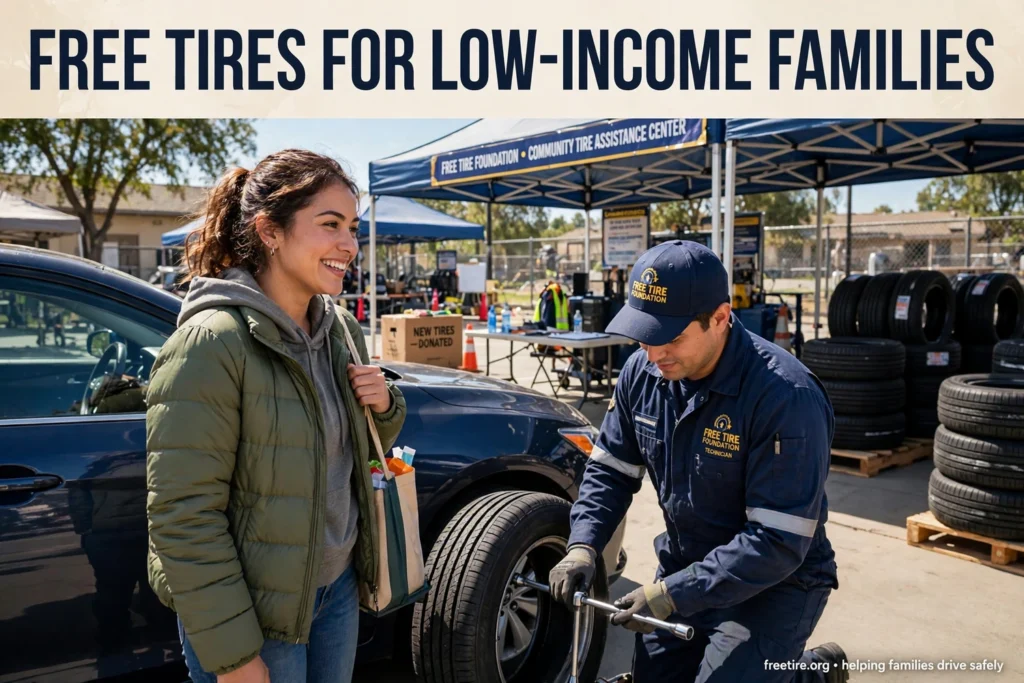
According to the foundation’s published information:
- Approved applicants may receive new or inspected used tires.
- Mounting and balancing are advertised as included at no cost.
- Priority is described for households at or below 200% of the federal poverty level and certain households receiving public benefits.
- Single parents, seniors, veterans, and people with disabilities are listed among its priority groups.
- People throughout the United States can apply, although the organization says it may provide local referrals when direct assistance is unavailable.
- Its stated response window is generally five to ten business days.
These are the organization’s own published descriptions, rather than independently verified guarantees of service. Before submitting sensitive documents or arranging a visit, confirm that applications are open and that assistance is available where you live.
Nationwide application access also does not necessarily mean nationwide tire delivery or installation. Ask whether the foundation can arrange service at a shop near your ZIP code, whether your tire size is available, and whether approval covers the entire installed cost.
Questions to Ask Before Applying
Use these questions to establish what assistance would mean for your household:
- Are you currently accepting applications from my ZIP code?
- Can you provide tires directly in my area, or would you offer referrals?
- What income documents do you require?
- How many tires could an approved application cover?
- Are mounting, balancing, disposal, and applicable taxes included?
- Must I use a particular shop?
- Should I wait for written approval before scheduling installation?
Keep a copy of your application and any approval message. An application acknowledgment is different from confirmation that tires have been reserved.
Call 211 for Local Tire and Car Repair Referrals
211 connects people with community resources. Some regional 211 directories specifically include car repair assistance among their transportation resources. It is a referral route, so the organization you are referred to determines eligibility and availability. United Way 211
When calling, explain the underlying need rather than asking only for “free tires.”
For example:
“I live in ZIP code [ZIP]. My car needs replacement tires, and I cannot afford the installed cost. I need the vehicle to get to work and take my children to childcare. Are there any emergency car repair programs, charitable garages, or transportation funds serving my address?”
Ask for the organization’s name, contact details, service area, and whether you need a referral. Also ask whether the listing has been checked recently. A program may still exist while its repair budget is temporarily exhausted.
Useful search terms for a local directory include:
- Tire replacement assistance
- Emergency vehicle repair
- Charitable auto repair
- Transportation assistance
- Employment transportation support
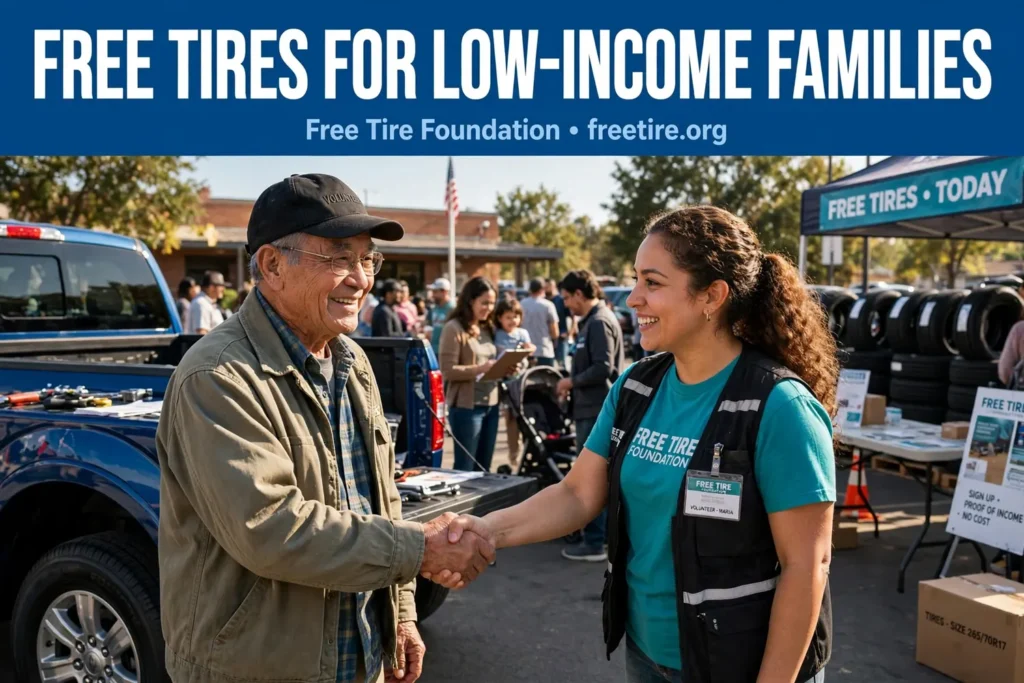
Charitable Repair Programs: Understand the Restrictions
A program does not have to advertise “free tires” to be worth contacting. Tires may be considered as part of a broader vehicle repair assessment. However, confirm tire coverage directly; general repair assistance does not establish that every repair is eligible.
Two published examples show why reading the requirements matters.
Working Wheels: A Referral-Based, Low-Cost Option
Working Wheels in western North Carolina operates a vehicle repair program through community partners. Its published terms say participants pay 10% of the repair cost, up to $100, and must already be engaged with an eligible partner organization. Individuals cannot submit applications directly. This is a reduced-cost repair route, and tire coverage requires confirmation. Working Wheels
Car Care Program: Free Labor May Still Leave Parts Costs
Minnesota’s Help Me Connect directory lists a Car Care Program serving eligible residents of Douglas, Pope, Stevens, and Otter Tail counties. Its requirements include a referral, income information, a driver’s license, insurance, and vehicle ownership documents. The listing explains that labor is free, but parts may involve a charge. Help Me Connect
These examples illustrate two important distinctions: free labor does not always mean a free repair, and meeting the income requirement does not remove referral or residency rules.
Ask Your Caseworker About Transportation Support
If you already work with a benefits office, employment service, family support agency, or disability support organization, ask whether your case can be assessed for vehicle repair assistance.
Frame the request around the practical barrier:
- Unsafe tires are preventing you from reaching work.
- A repair is necessary to begin an accepted job.
- Your vehicle is needed for an approved training activity.
- A transportation problem is interrupting essential caregiving.
Ask whether tire replacement is an allowable expense, whether you need an approved vendor, and whether a written estimate must be submitted first. Treat this as a request for an eligibility assessment, not an entitlement to a tire payment.
If a program requires advance authorization, paying for tires first could leave you responsible for the bill.
Who Qualifies for Free Tire Assistance?
There is no single income limit or application standard shared by all tire assistance providers. Each organization sets its own rules.
Prepare to answer questions about:
| Eligibility factor | Information to have ready |
|---|---|
| Household finances | Household size, income, benefits, and essential expenses |
| Residence | Address and ZIP code |
| Vehicle access | Ownership or registration information |
| Driving requirements | License and insurance, if requested |
| Transportation need | Why the vehicle is necessary |
| Repair need | Written inspection findings and an itemized estimate |
| Program access | Caseworker or agency referral, when required |
Receiving SNAP, Medicaid, SSI, or another benefit may help document financial circumstances where a provider accepts it. Benefit participation should not be treated as automatic approval for tires.
Likewise, being a single parent, veteran, senior, or person with a disability may be relevant to a particular program, but applicants still need to check its full requirements.
How to Apply Without Delaying Your Request
1. Get the Tire Problem Assessed
Ask a qualified tire shop to identify which tires need attention and provide a written estimate. This helps establish whether you need a replacement, a repair, or further inspection.
Ask the shop to record the tire size and explain the reason for replacement. A specific diagnosis is more useful to an assistance provider than “the tires are bad.”
2. Request an Itemized Installed Price
The tire price alone may not reflect the amount needed to put the vehicle back on the road.
Ask the estimate to separate:
- Tires
- Mounting and balancing
- Valve stems or required tire pressure sensor work
- Disposal charges
- Taxes
- Any separately recommended alignment or additional repair
Ask which items are necessary and which are optional. If the estimate includes alignment or suspension work, request an explanation of the problem it addresses.
3. Gather Documents Before Starting Applications
Keep clear copies of the documents requested by each provider. Depending on its rules, these could include identification, proof of address, income records, vehicle registration, insurance, and the shop estimate.
Submit sensitive documents through a verified channel. Do not send financial or identity records to an account simply because it uses a charity’s name.
4. Contact More Than One Appropriate Resource
Submit applications only where you meet the service-area and access requirements. You can also seek referrals while an application is pending.
Tell providers if another organization has approved part of the bill. Ask whether combined funding is permitted and how payment would be coordinated.
5. Confirm Approval Before Installation
An approval should make clear:
- The amount or service covered
- The authorized shop
- Your contribution, if any
- Any approval expiration date
- Whether the provider pays the shop directly
If the tire size or final price changes, ask whether the authorization needs updating.
A Short Script for Requesting Tire Assistance
A clear request helps staff understand the need quickly:
“I’m seeking assistance with replacement tires for my [year, make, and model]. I live in [ZIP code], and my household cannot afford the repair. A tire shop has provided an estimate of [$amount], including installation. I need the vehicle for [work, childcare, or another essential purpose]. Do you cover this type of expense, and what documents or referral would I need?”
If you have an urgent deadline, state it accurately. Include a confirmed job start date or appointment date when relevant, without exaggerating the circumstances.
What to Do If Free Tires Are Unavailable
A denial may reflect exhausted funding, geographic restrictions, or a referral requirement. Ask the provider which issue applies before deciding your next step.
Ask About Partial Assistance
If a program cannot cover the entire estimate, ask whether it can contribute toward the approved repair. Then obtain a revised balance from the shop.
For example, a $200 contribution toward an illustrative $360 installed bill would leave $160 to resolve. Confirm both the contribution and remaining amount before authorizing work.
Compare Complete Quotes
Compare the same tire size and an equivalent installed service. A lower advertised tire price can become more expensive once required charges are added.
Ask each shop for its final total and whether a suitable lower-cost tire is available. Let the technician determine what is appropriate for the vehicle.
Have Used Tires Professionally Assessed
Remaining tread alone does not establish a tire’s condition. Ask a qualified shop about age, damage, previous repairs, compatibility, and any warranty before buying used tires.
NHTSA advises that tire condition, aging, physical damage, and changes in performance all matter when deciding whether tires should remain in use. NHTSA
Arrange Temporary Transportation
If the vehicle cannot be used safely, ask about transportation help while repairs are pending. United Way’s Ride United program connects eligible people with essential rides in participating communities. Availability and application arrangements vary locally; 211 or a local United Way can explain the options. United Way Worldwide
Describe the specific trip you need, including its date and destination. A temporary ride can help protect a work shift or appointment while you continue seeking tire assistance.
Tire Safety While You Wait
An assistance application does not make a damaged tire safe to use.
NHTSA says tires should be replaced when tread reaches 2/32 of an inch. It also identifies physical damage, irregular wear, air-pressure problems, noise, and vibration as reasons to stop using a tire or seek professional advice, depending on the condition. NHTSA
If you notice exposed cords, a bulge, significant damage, or a tire that will not hold air, arrange professional guidance rather than continuing normal driving while waiting for approval.
Ask the shop whether the vehicle can be moved safely and what transportation or towing arrangements are needed.
Frequently Asked Questions
Can I Get Free Tires Near Me?
Possibly, but availability is local and often limited. Check Free Tire Foundation’s current arrangements for your ZIP code, contact 211, and ask existing caseworkers about repair assistance. Confirm whether a provider supplies tires directly or only offers referrals.
Does Free Tire Assistance Include Installation?
Some programs advertise installation as included; others cover only parts or provide free labor. Ask specifically about mounting, balancing, disposal, taxes, and required sensor work before accepting an offer.
Can Unemployed People Apply?
Employment requirements differ. Free Tire Foundation’s website says job seekers can apply, while other programs may require employment, school enrollment, caregiving responsibilities, or a qualifying referral. Check the individual program rather than assuming unemployment qualifies or disqualifies you.
Can I Get Four Free Tires?
The number covered depends on the provider’s authorization, available inventory, and the vehicle’s assessed needs. Ask what the approval includes and have the shop confirm the appropriate replacement arrangement for your vehicle.
Will an Organization Reimburse Tires I Already Bought?
Do not assume reimbursement is available. Before purchasing, ask whether the provider requires prior approval and direct payment to an authorized shop.
What Should I Do First?
Get a written assessment and an itemized installed estimate. Then contact assistance providers with your ZIP code, tire size, amount needed, and reason the vehicle is essential. Those details make it easier to identify a program that can realistically help.